TL;DR: – The founder-to-CEO transition is primarily an identity problem, not a skills gap – the behaviors that built your company will actively undermine it past 50 employees.
- Five concrete identity shifts, combined with a tiered decision-making system, form the operational infrastructure of a CEO mindset.
- The first 90 days are the highest-leverage window for installing new systems before old habits calcify permanently.
A founder closes his laptop at midnight, having personally approved fourteen decisions that day – vendor invoices, a sales deck revision, a customer refund, a hiring panel schedule. His company has 60 employees and a Series B closing in six weeks. His leadership team has stopped bringing solutions. They only surface problems. The bottleneck is not the market, the product, or the capital. The bottleneck is him.
This scenario is not an anomaly. It is the default trajectory for founders who have not made the transition from founder to CEO mindset. Understanding how to transition from founder to CEO mindset is not about acquiring new skills in isolation – it is about dismantling the operating identity that made you successful and replacing it with one built for scale.
Why the Founder Mindset Stops Working at Scale
The founder mindset is a survival mechanism. Speed, direct control, and personal execution are precisely the behaviors that get a company from zero to product-market fit. The problem is that these same behaviors become structural liabilities once the organization grows beyond informal coordination.
According to Nexford University's analysis, startups with strong leadership teams outperform solo founders by 163% and achieve valuations 25% higher. That gap does not emerge from product quality – it emerges from the founder's willingness and ability to build and trust a leadership layer. As jakesmolarek.com's research synthesis notes, the ceiling typically appears once teams pass 7–10 people, when informal decision-making starts to collapse under the weight of complexity.
The symptoms are observable and specific. Your team asks you more than ten questions per day on decisions they could resolve independently. Meetings stall without your presence. New hires calibrate their behavior to what they think you want rather than what the role requires. These are not signs of a weak team – they are signs of a founder who has unintentionally trained learned helplessness into the organization.
| Founder Behavior | CEO Behavior |
|---|---|
| Makes decisions to maintain speed | Builds systems so decisions happen without them |
| Solves problems directly | Develops people who solve problems |
| Carries culture through presence | Encodes culture into hiring, rituals, and standards |
| Operates on daily urgency | Operates on quarterly and annual horizons |
| Measures output personally | Measures organizational throughput |
Spencer Stuart's research on leadership transitions identifies a critical timing problem: the point at which a founder voluntarily steps back from an operating role is almost always six months after the optimal moment. The cost of that delay compounds – in organizational confusion, team disengagement, and board confidence erosion.
Understanding emotional intelligence in leadership is part of what makes this transition psychologically difficult. The behaviors being dismantled are not just habits – they are identity.
Key Takeaway: The founder mindset is optimized for survival, not scale. Once your team exceeds 10–15 people, the behaviors that built the company begin actively limiting its ceiling. The transition is not optional – it is structural.
What Does a CEO Mindset Actually Look Like?
A CEO mindset is defined not by personality traits but by observable, measurable behaviors. The distinction matters because it moves the conversation from the abstract ("be more strategic") to the concrete ("here is what you should be doing differently on Tuesday morning").
Four observable CEO behaviors distinguish the role from the founder operating mode. First, decisions are made without the CEO in the room – not because the CEO is absent, but because the decision architecture makes their presence unnecessary for operational and tactical choices. Second, the CEO's calendar reflects 60% or more of time allocated to strategic priorities, people development, and external relationships, consistent with Harvard Business Review's landmark time-use study by Porter and Nohria, which tracked 27 CEOs across 13 weeks. Third, the CEO's primary output is the quality of the leadership team, not the quality of individual work product. Fourth, the CEO is developing executive presence that communicates organizational direction clearly to boards, investors, and senior hires – a capability distinct from the internal credibility founders build through technical expertise.
There is also an important distinction between two CEO archetypes that founders must navigate consciously. The operator CEO focuses on execution infrastructure – process, accountability, and organizational efficiency. The visionary CEO focuses on market positioning, product direction, and long-term bets. Most founders default to a hybrid that serves neither function well. The transition requires choosing a primary orientation and building a complementary leadership team to cover the other.
Self-Assessment: Five Diagnostic Questions
Answer these honestly before reading further:
- What percentage of your working hours last week were spent on work only you can do?
- How many decisions did your team escalate to you that they had the information to resolve themselves?
- If you were unreachable for five business days, what would break – and why?
- When did you last spend two or more consecutive hours on a decision with a 12-month or longer horizon?
- Does your team bring you solutions or problems?
If your answers reveal a pattern of reactive, execution-heavy involvement, you are operating as a founder. Developing executive presence as a CEO requires a fundamentally different operating posture.
Key Takeaway: CEO mindset is observable, not abstract. If decisions require your presence, your calendar is dominated by execution, and your team escalates problems rather than solutions, you are not yet operating as a CEO – regardless of your title.
The 5 Identity Shifts Every Founder Must Make
First Round Review's interview with Instagram co-founder Mike Krieger captures the core insight precisely: "The transition isn't really about learning new skills. It's about adopting a new identity – seeing yourself as a leader of leaders rather than the best individual contributor in the room." These five shifts operationalize that identity change.
Shift 1: From Doer to Decision Architect
Before: You make decisions because you are the fastest, most informed person to make them. Speed feels like leadership.
After: You design the system that determines who makes which decisions, with what information, and by what criteria. Your value is in the architecture, not the answer.
The practical tool here is a decision filter. For every decision that reaches you, ask three questions: Does this require my judgment specifically? Does this set a precedent that affects company direction? Is the cost of a wrong decision irreversible? If the answer to all three is no, the decision belongs elsewhere. Build that filter into your team's operating norms explicitly.
Shift 2: From Expert to Talent Multiplier
Before: You are the best person in the room on the most important problems. Your expertise is your authority.
After: Your job is to make your team collectively more capable than you are individually. Your expertise becomes a coaching resource, not an execution resource.
Nexford's analysis notes that founder-CEOs who learn to delegate effectively are far more likely to lead companies that outperform competitors and sustain rapid growth. Building a high-trust leadership team is the prerequisite – delegation without trust produces micromanagement with extra steps. The concrete action: identify your three highest-leverage direct reports and commit to one structured coaching conversation per week focused on their development, not your agenda.
Shift 3: From Short-Term Fixer to Long-Horizon Strategist
Before: Your day is organized around what is on fire. Urgency drives your calendar.
After: Your week is organized around what matters in 12 to 36 months. You protect strategic time the way you protect revenue.
Global Tech Assets' guide on the founder-to-CEO process frames this precisely: the focus transitions from day-to-day operations to the big picture, from firefighting challenges to crafting long-term strategies. The concrete action: block two hours every Monday morning for strategic work – market analysis, organizational design, competitive positioning – and treat that block as non-negotiable as a board meeting.
Shift 4: From Culture Carrier to Culture Designer
Before: Culture exists because you are present. Your energy, standards, and behavior set the tone in every room you enter.
After: Culture exists in systems – hiring criteria, onboarding processes, performance standards, and rituals – that operate independently of your presence.
Radium Capital's research identifies a critical threshold: once your team exceeds 50 people, the culture of your business will assume a life of its own. The question is whether you designed that life deliberately or allowed it to emerge by default. The concrete action: document the three non-negotiable behavioral standards that define your culture and embed them explicitly into your hiring scorecard and performance review process.
Shift 5: From Founder Identity to CEO Role
Before: The company's performance is your personal scorecard. Its failures feel like personal failures. Its success is your identity.
After: You are a person who leads this company. The company's performance reflects the quality of the system you have built – not your personal worth.
This is the hardest shift because it is psychological, not operational. Harvard Business School Working Knowledge's reporting on founder psychology documents that founders who define their identity through their company often experience loss of control as a form of personal failure, triggering emotional responses that override rational decision-making. The concrete action: establish one domain of your life – physical training, a creative pursuit, a relationship investment – that is entirely separate from company performance and non-negotiable in your weekly schedule.
Key Takeaway: These five shifts are sequential in difficulty but parallel in execution. Begin with Shift 1 (decision architecture) because it creates the structural space for the others to follow. Identity change without structural change produces good intentions and no behavioral difference.
How Do You Build CEO-Level Decision-Making Systems?
Decision-making systems are the operational infrastructure of a CEO mindset. Without them, identity shifts remain aspirational. Research consistently shows that companies with clear decision accountability make decisions faster and execute them more effectively. That speed advantage compounds at scale.
The Three-Tier Decision Framework
Organize every recurring decision type into one of three tiers:
- Strategic (CEO only): Decisions that set direction, allocate significant capital, or establish precedent. Examples: entering a new market, changing pricing architecture above $50K impact, executive hiring and firing, board-level commitments.
- Operational (Leadership Team): Decisions within established strategy that require cross-functional coordination. Examples: pricing changes between $5K and $50K handled by VP Sales, departmental budget reallocations within approved ranges, hiring decisions for senior individual contributors.
- Tactical (Individual Contributors): Decisions within established operational parameters. Examples: pricing adjustments under $5K handled by sales lead, customer service resolutions within defined policy, project scheduling within approved scope.
The specific thresholds matter. Ambiguity is the enemy of delegation. When your team knows that pricing changes under $5K are theirs to make, they stop asking. When the threshold is undefined, every decision feels like it might require escalation.
If your team is asking you more than ten questions per day, that is a diagnostic signal: either the decision tiers are not defined, the team does not trust the framework, or you have not consistently enforced it by redirecting decisions back to the appropriate tier. The fix is not to answer faster – it is to build accountability systems for leadership teams that make the framework self-enforcing.
The Meeting Cadence Shift
Founders typically operate in a continuous reactive mode – Slack, ad hoc conversations, and daily standups that function as decision queues. CEOs operate on a structured weekly rhythm that separates strategic, operational, and tactical conversations into distinct forums.
A functional CEO meeting cadence includes: a weekly leadership team meeting focused on cross-functional priorities and blockers (not status updates), a monthly strategic review focused on leading indicators and 90-day priorities, and a quarterly planning session that resets organizational focus. Daily firefighting happens at the team level – not in your calendar.
Key Takeaway: Decision tiering with specific thresholds eliminates the ambiguity that drives upward delegation. If your team asks you 10+ questions per day, the system is broken – not the people. Define the tiers, enforce the boundaries, and measure the reduction in escalations over 30 days.
Your 90-Day Founder-to-CEO Transition Plan
Michael Watkins' research on leadership transitions establishes a clear principle: new leaders who deliberately restructure their decision-making and time allocation in the first 90 days set a trajectory that compounds. Those who delay default to prior habits indefinitely. The transition is not gradual – it is installed.
Days 1–30: Audit Your Current Operating Mode
The first phase is diagnostic. You cannot redesign a system you have not measured. Conduct a time audit for two full weeks: log every activity in 30-minute blocks and categorize each as strategic, operational, or tactical. Most founders discover that 65–75% of their time sits in the operational and tactical categories – the inverse of the CEO target.
Simultaneously, run a decision log: record every decision you make for two weeks, who brought it to you, and whether it required your judgment specifically. By day 30, you should know where 80% of your time goes and be able to identify your top three bottleneck behaviors – the recurring decision types or activities that only you handle but that others could own with the right framework.
Common failure mode: Treating the audit as confirmation of how hard you work rather than as a diagnostic for redesign. The data is not a badge – it is a blueprint for what to stop doing.
Days 31–60: Build the Delegation Infrastructure
The second phase is structural. Using your decision log, define the three-tier decision framework with explicit thresholds for your organization. Identify the first layer of functional leaders – whether existing team members being promoted or new hires – who will own operational decisions in their domains.
Install the decision filter as a team norm: when someone brings you a decision, ask them which tier it belongs to and what they recommend. This single behavioral change begins shifting the team from problem-surfacers to solution-owners. Microenterprise Collaborative's guidance on the self-employed-to-CEO transition frames this well: delegation implies empowering, not micromanaging.
Common failure mode: Delegating authority without delegating context. Your team needs to understand the reasoning behind decisions, not just the decision rights. Invest time in the first 30 days of delegation in explaining the "why" behind your judgment calls – this is how you transfer decision-making capability, not just decision-making responsibility.
Days 61–90: Operate as a Strategic CEO
The third phase is the operating shift. By day 61, your decision infrastructure should be functional enough that you can restructure your calendar to reflect 60% strategic allocation. This means protecting time for market analysis, organizational design, board relationships, and long-horizon planning – and actively declining to fill that time with operational work that has been delegated.
Schedule a leadership team offsite during this phase to align your leadership team on the new operating model, clarify decision rights, and establish the quarterly planning rhythm. This session is not a retreat – it is the formal installation of your new operating system as an organization.
Common failure mode: Reverting under stress. The first major crisis after delegation will create pressure to recentralize. Recognize this pattern in advance and treat it as a test of the system, not evidence that delegation does not work.
Key Takeaway: The 90-day plan is not about transformation – it is about installation. Audit in days 1–30, build infrastructure in days 31–60, and operate from the new model in days 61–90. Measure progress by reduction in decision escalations and increase in strategic calendar allocation.
Taking Action on the Transition
The founder-to-CEO transition is a system problem, not a motivation problem. Knowing what to do is necessary but insufficient – the behavioral change requires structured accountability and, often, an external perspective that can identify blind spots the founder cannot see from inside the organization.
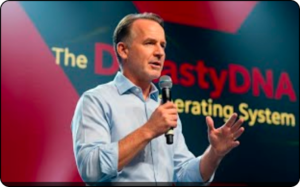
George Dupont Leadership offers leadership coaching and culture transformation work specifically designed for founders and executives navigating this kind of identity-level transition. The DynastyDNA Leadership framework treats leadership as a system – not a personality trait – which aligns directly with the structural approach outlined in this guide. If you are at Series A or B and recognizing the patterns described here, structured coaching support during the 90-day installation phase materially increases the probability of the transition sticking.
Frequently Asked Questions
How long does the founder-to-CEO transition typically take?
Direct Answer: The behavioral infrastructure can be installed in 90 days, but full embedding of the new operating identity typically takes 12–24 months.
The first 90 days establish the structural foundations – decision tiers, delegation frameworks, and calendar redesign. The subsequent months are about reinforcing those structures under stress, particularly during crises that create pressure to revert to founder-mode behaviors. Expect regression during high-pressure periods and treat it as a calibration signal, not a failure.
What is the difference between a founder mindset and a CEO mindset?
Direct Answer: A founder mindset is optimized for speed, personal execution, and direct control. A CEO mindset is optimized for organizational throughput, system design, and leadership multiplication.
As Global Tech Assets describes it, the shift moves you from being the doer to the leader – from carrying the torch personally to empowering others to carry it. The founder mindset is not wrong; it is simply misapplied once the organization requires coordination across more than one layer of leadership.
How much does executive coaching cost to support a founder-to-CEO transition?
Direct Answer: Executive coaching engagements for founders and CEOs typically range from $500 to $1,500 per session, with ongoing monthly engagements varying based on scope and coach experience.
The relevant question is not cost but return. The International Coaching Federation has reported that many coaching recipients report improvements in work performance, relationships, and communication effectiveness. For a founder managing a Series A or B company, the leverage on even marginal improvements in decision quality and leadership effectiveness far exceeds the coaching investment. For structured support on this transition, exploring executive coaching ROI for founders is a practical starting point.
What are the most common reasons founders fail to make the CEO transition?
Direct Answer: The primary failure mode is identity attachment – founders who cannot separate their personal worth from company performance resist the delegation and role redefinition that the transition requires.
Harvard Business School Working Knowledge's reporting documents that founders who define their identity through their company experience loss of control as a form of personal failure. Secondary failure modes include delegating authority without delegating context, reverting to founder behaviors under stress, and building a leadership team that mirrors the founder's strengths rather than complementing their gaps.
When should a founder bring in an outside CEO instead of making the transition themselves?
Direct Answer: An outside CEO is warranted when the capability gap is real, the learning curve is longer than the company's competitive window, and board confidence has materially eroded.
Spencer Stuart's research is direct on this point: when performance is declining steeply, boards that move faster to replace the CEO greatly improve the chances for positive recovery. The decision should be driven by honest capability gap analysis, not founder insecurity. If the required skills – typically enterprise sales leadership, operational scaling, or public company governance – are genuinely outside the founder's development trajectory, the company's interests must take precedence.
How do you let go of control without losing company culture?
Direct Answer: Culture scales through systems – documented values, hiring criteria, behavioral standards, and rituals – not through founder presence.
Radium Capital's analysis identifies the threshold clearly: once your team exceeds 50 people, culture assumes a life of its own. The founder's job is to design that life deliberately before stepping back. Cascading company vision through your organization via structured onboarding, explicit behavioral standards, and consistent leadership modeling is how culture survives the founder's operational exit.
Can introverted founders develop the external CEO presence required at scale?
Direct Answer: Yes. Introversion is not a barrier to CEO effectiveness – it is a different operating style that carries distinct advantages in leadership contexts.
Research by Adam Grant, Francesca Gino, and David Hofmann, published in the Academy of Management Journal, found that introverted leaders outperform extroverted leaders when managing proactive employees – they listen more carefully and create space for team ideas to surface. The external CEO presence required at scale – board communication, investor relationships, executive hiring – is a learnable skill set, not a personality requirement. Structured preparation, clear communication frameworks, and deliberate practice close the gap effectively.
Ready to Get Started?
For personalized guidance, visit Leadership Coaching and Culture Transformation to learn how we can help.
Conclusion
The founder-to-CEO transition is not a graduation – it is a deliberate dismantling and reconstruction of how you operate. The behaviors that built your company are not wrong; they are simply mismatched to the organization you are now leading. Five identity shifts, a tiered decision-making system, and a structured 90-day installation plan provide the architecture for that reconstruction.
Talent sets the floor. Leadership and culture set the ceiling. The question is not whether you are capable of making this transition – it is whether you are willing to build the system that makes your capability irrelevant to daily operations. That is what a CEO does.